
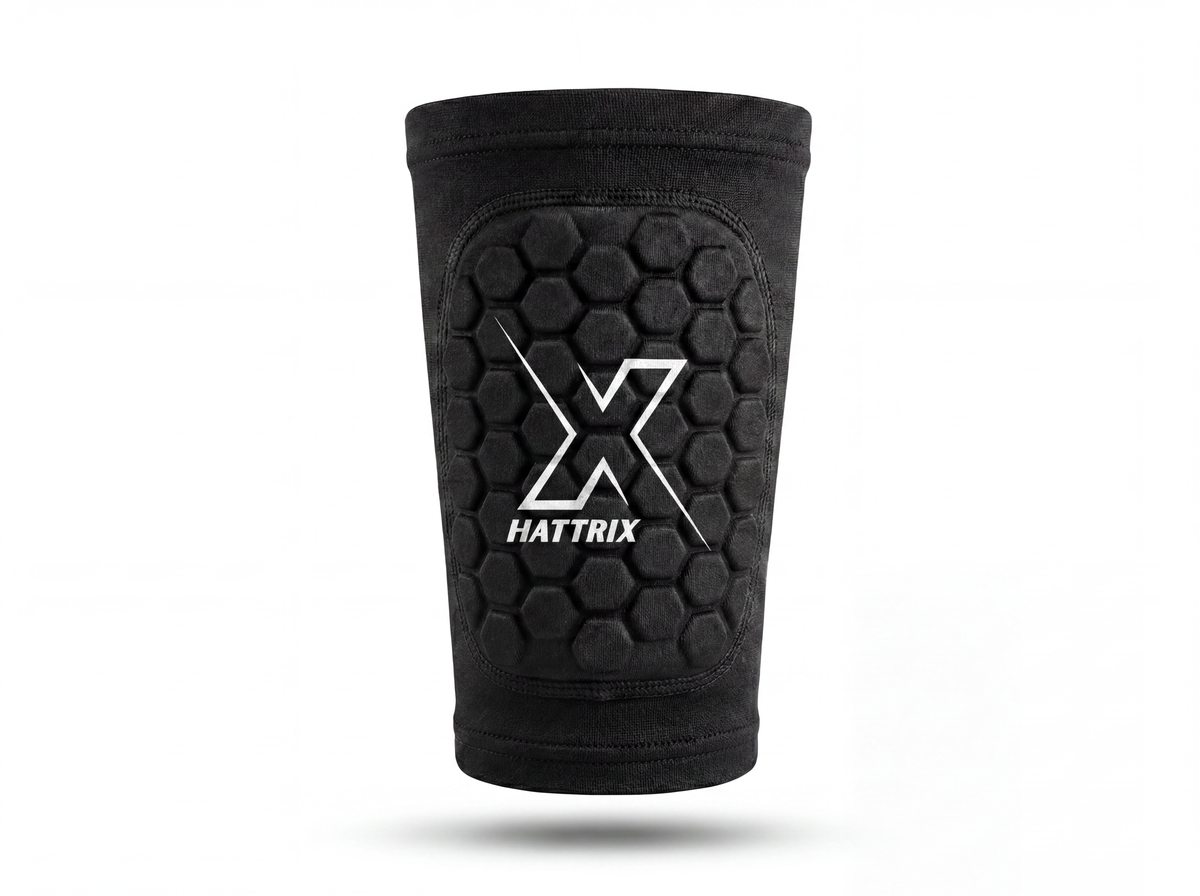
Your child is ready to play. Then comes the familiar pause: socks down, shin pads adjusted, socks back up.
If that keeps happening, it is worth checking their setup. Comfortable shin pads should let a young player get on with enjoying football, rather than thinking about their kit.
Choosing the right pair starts with three things: sleeve fit, protective coverage and how they feel when your child moves.
Start with measurements, not just age
Age labels are a useful starting point, but children grow at different rates. Two players in the same team can need different sizes.
For Hattrix compression shin pads, measure around the upper calf where the sleeve sits. Use a soft tape measure against the skin, keeping it level without pulling it tight. Check both legs and compare the measurements with the guide for the exact product you are buying.
Do not assume a size small in one range will fit like a small in another. If a measurement falls into more than one size band, ask for help rather than guessing.
Check sleeve fit and shin coverage separately
A snug sleeve and a suitably sized protective pad are two different checks.
The sleeve helps hold the padding in position. The padding is the protective part. A sleeve can feel comfortable while the pad itself provides too little coverage for that player.
Look at where the protective area sits on the front of the shin. Check that the setup does not interfere with bending the knee or moving the ankle. Do not choose a tiny pad simply because a favourite professional wears one.
Under IFAB Law 4, shin guards must use suitable materials, be appropriately sized to provide reasonable protection, and be covered by socks. These are football’s rules, rather than a general UK legal requirement for every kickabout. Check any additional club or competition requirements too.
Why staying in place matters
If a pad slips or turns, it may leave part of the area it was covering exposed. Keeping suitable padding correctly positioned matters; a tight sleeve alone does not establish how much impact protection a product offers.
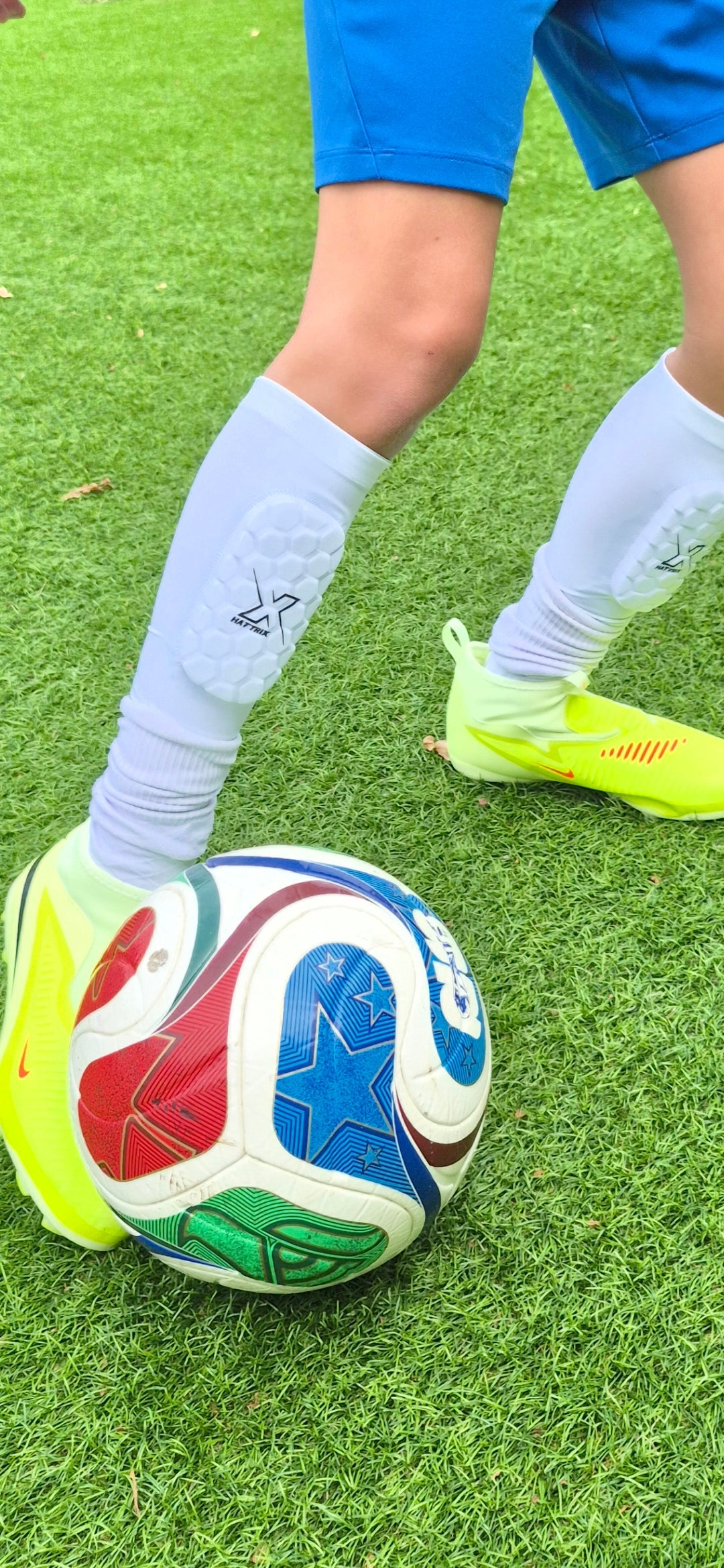
Hattrix compression designs hold the padding close to the shin, with no tape needed. That can make getting ready simpler and help reduce repeated adjusting when the fit is right.
Traditional guards can also stay secure with a well-fitted sleeve, straps or socks. The useful test is how the complete setup works on your child.
Less fiddling with kit may help a player feel more settled and confident. It does not make any shin pad injury-proof. Laboratory research shows that impact protection varies between guard designs; it does not prove Hattrix compression pads prevent more injuries than traditional guards.
Do a quick movement check
Try the pads with the socks and boots your child normally wears. Then ask them to jog, bend their knees, turn and make a few gentle passes.
Check together:
- Does the padding stay over the shin?
- Does the sleeve feel snug without pinching?
- Can they move their knees and ankles comfortably?
- Are the pads covered by their football socks?
- Are they repeatedly pulling or twisting anything back into place?
Ask how the kit feels, too. If something hurts, rubs or feels too tight, stop and reassess the fit. Avoid buying an oversized pair for them to grow into if it moves around now.
Find their fit with Hattrix
Our Junior Matchday Pro Shin Pads are listed for ages 7–12. Older players can explore Stay Locked Compression Shin Pads, listed for ages 13+.
Use each product’s current size guide, then check comfort and coverage on the individual player. Recheck after growth spurts and whenever the fit changes.
Unsure which option to choose? Contact Hattrix with your child’s age and calf measurements before ordering.
Less adjusting. More enjoying the game. Play with confidence.
Sources
IFAB Law 4 — The Players’ Equipment
The Effectiveness of Shin Guards Used by Football Players (2014) — laboratory research on specific guards, not Hattrix products.


Leave a comment
This site is protected by hCaptcha and the hCaptcha Privacy Policy and Terms of Service apply.