
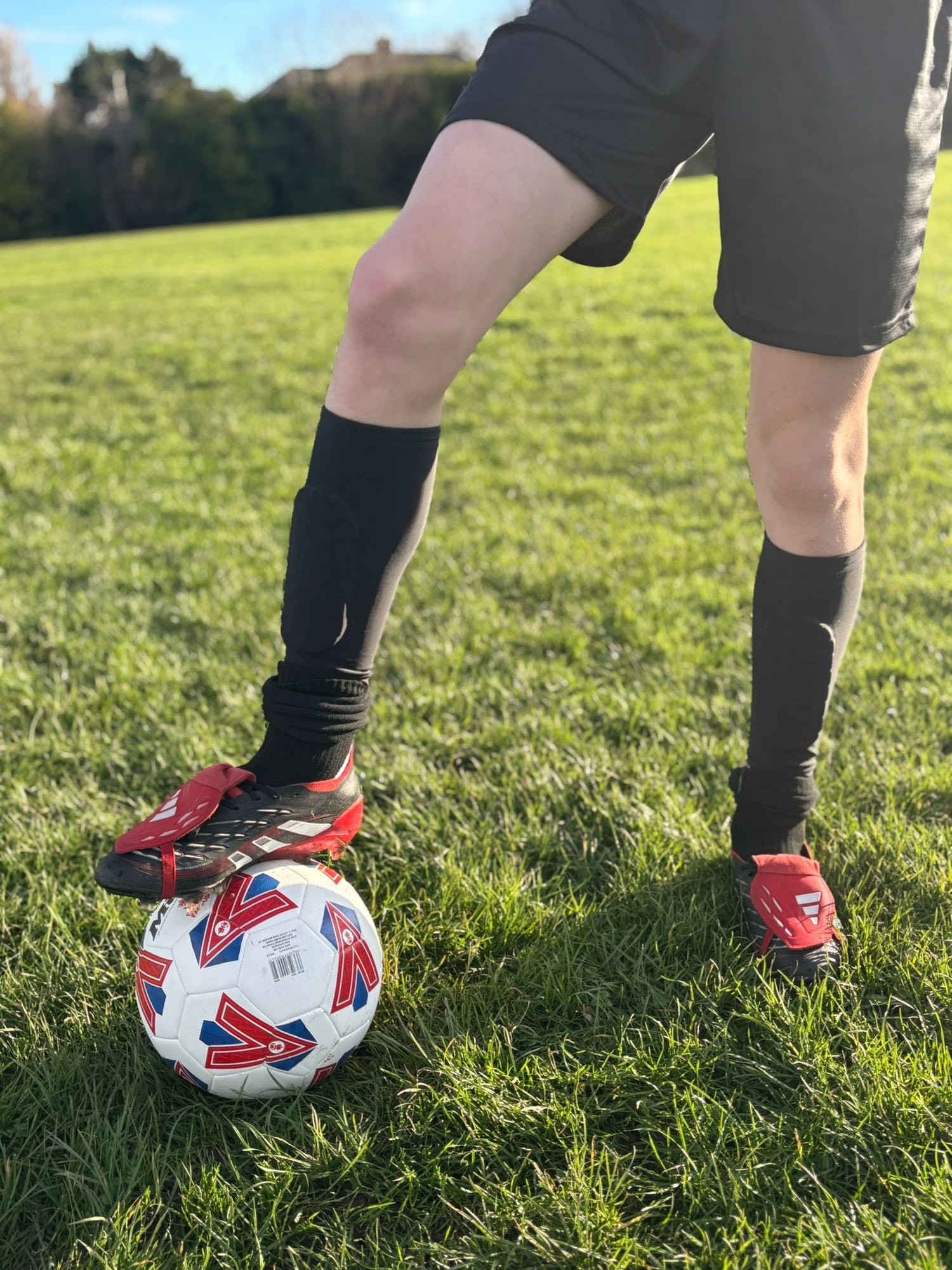
Footballers across the UK — from grassroots to elite level — are switching to grip socks. Not because they’re trendy, but because they genuinely change how you move, how you cut, and how confidently you control your game.
If you’ve ever felt your foot slide inside your boot, lost balance during a turn, or struggled with blisters from friction, you’ve already experienced the exact problems grip socks were designed to fix.
This article breaks down:
- What grip socks actually do
- Why players say they feel “locked in”
- How they reduce injury risk
- Whether they really make you quicker and more stable
- Why boot manufacturers haven’t solved this problem
1. The Science Behind Foot Slippage in Football Boots
Football boots are intentionally made smooth inside to reduce manufacturing issues — but that smoothness creates a problem:
Your foot moves before your boot does.
Micro-slips (tiny internal movements) occur during:
- Sprint take-off
- Sharp directional changes
- Deceleration
- Striking the ball
- Jump landings
Even a few millimetres of movement can cost:
- Balance
- Speed
- Power transfer
- Reaction time
Over a 90-minute match, those micro-slips add up to inconsistent performance and high injury risk.
Grip socks solve this by creating traction within the boot itself, giving your foot a locked-in feel that boots simply can’t provide alone.
2. How Grip Socks Improve Stability & Explosiveness
High-quality grip socks use silicone or rubberised pods to create multi-directional traction.
This traction:
- Prevents heel lift
- Prevents sideways slipping
- Keeps your forefoot stable during cuts
- Helps maintain explosive power transfer
In simple terms:
When your foot doesn’t move, your speed becomes more direct, your force becomes more efficient, and your confidence skyrockets.
Studies on friction-based footwear systems show:
- Up to 20% faster acceleration
- Up to 35% better lateral stability
- Significant improvement in power transfer efficiency
3. Injury Prevention: Grip Socks Reduce the Hidden Risks
Common football injuries linked to foot instability include:
- Sprained ankles
- Metatarsal stress
- Achilles irritation
- Blisters & skin tearing
- Turf toe
When the foot shifts inside the boot, your body naturally over-compensates. Grip socks create internal stability, which supports:
- Better joint alignment
- Safer landings
- Reduced friction burn
- More efficient biomechanics
For youth players especially, this stability can make a massive long-term difference.
4. Blister Prevention: Why Grip Socks Work Better Than Boot Tape
Traditional boot tape adds external compression.
Grip socks work internally, eliminating friction before it becomes a problem.
Friction occurs when:
- Sweat increases slipperiness
- The foot rubs against boot material
- Boots aren’t fully broken in
- Rapid direction changes increase pressure
Grip socks create a consistent hold, reducing the repetitive rubbing that causes blister formation.
5. Do Grip Socks Make You Faster?
Yes — indirectly, but noticeably.
Speed in football comes from efficient interaction between:
- Ground force
- Stability
- Foot-to-boot connection
- Balance during acceleration
When you cut out internal slipping, you maximise all four.
Player feedback shows improvements in:
- Sprint take-offs
- 1v1 dribbling changes
- Quick turns
- Recovery speed
- Ball striking consistency
Even a 1% speed improvement matters — and grip socks often deliver significantly more.
6. Why Pros Don’t Wear Regular Club Socks
If you’ve ever noticed a pro player cutting their match socks, it’s because:
Most pros wear grip socks underneath.
Club-issued socks offer minimal traction, so players customise their kit to get the best of both worlds:
- Grip socks for performance
- Cut socks for uniform compliance
This trend began at the top level but has now filtered down through academies and grassroots teams.
7. Why Hattrix Grip Socks Make a Difference
Hattrix grip socks are engineered specifically for footballers, featuring:
- High-traction grip pods for multi-directional stability
- Breathable mesh zones for moisture control
- Arch compression for reduced fatigue
- Reinforced heel & toe areas
- Padded impact zones for comfort
We designed them around the pain points footballers actually experience — because we’re players too.
Final Thoughts
Grip socks aren’t a gimmick — they’re an evolution of football equipment.
They solve real biomechanical problems, reduce injury risk, and give players the stability their boots can’t provide alone.
If you’re training seriously, wanting more confidence on the ball, or looking to break past performance plateaus, grip socks can make a surprising difference.


Leave a comment
This site is protected by hCaptcha and the hCaptcha Privacy Policy and Terms of Service apply.