
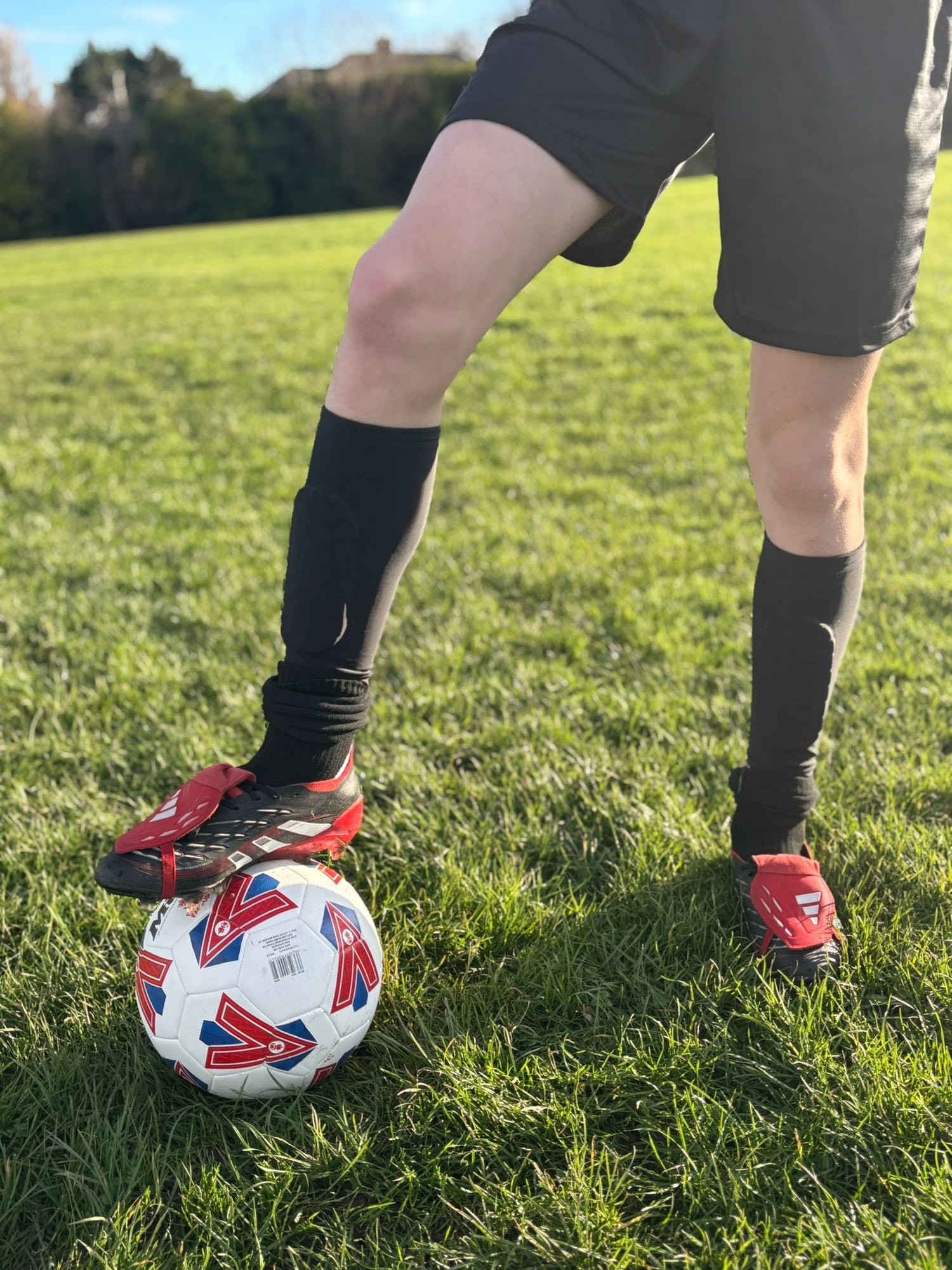
Football shin pads are one of the most universally hated pieces of kit.
Too bulky.
Too itchy.
Always sliding around.
Always needing adjustment.
But shin pads aren’t optional — they’re your only protection against tackles, studs, and accidental collisions.
So why are they so uncomfortable, and why do so many players struggle with them?
In this deep dive, we’ll explore:
- The real reasons shin pads become uncomfortable
- What happens biomechanically during contact
- How new designs (like Hattrix pads) improve comfort and protection
- Whether sleeve-style pads outperform strapped models
- How sizing impacts performance
1. The Problem: Traditional Shin Pads Were Never Designed for Comfort
Older shin pads were:
- Thick
- Heavy
- Poorly ventilated
- Not shaped to the leg
- Made from stiff plastics
Players simply “put up with them” because there were no alternatives.
But football has changed — speed is faster, impacts are harder, training is more intense. Comfort, mobility, and breathability have become essential.
2. Why Shin Pads Slip (And Why It Matters)
Pads mainly slip because:
- Sweat reduces friction
- Socks stretch during play
- Straps restrict blood flow
- Pads aren’t anatomically shaped
- Poor compression around the calf
Pads that move during play don’t just annoy you — they increase injury risk.
If the pad isn’t aligned at the moment of impact, protection fails.
Modern pads solve this with compression sleeves that:
- Lock the pad against the leg
- Maintain secure placement
- Improve breathability
- Reduce irritation
3. Impact Biomechanics: Why You Need Proper Protection
A football tackle can deliver forces similar to:
- A hammer strike
- A small car door closing on your leg
- A 20mph object hitting the tibia
The tibia is the body’s most commonly fractured long bone in football.
Proper shin pads distribute impact shock through:
- Foam dampening
- Hard shell dispersion
- Anatomical shaping
- Sleeve pressure support
Without these, the tibia absorbs the full force.
4. Lightweight Pads vs Heavy Pads: Which Is Better?
Old pads used heavy plastics for impact resistance.
Modern pads use:
- EVA foam
- Polycarbonate
- Anti-shock composites
These materials are:
- Lighter
- More breathable
- More flexible
- Equally (or more) protective
This combination improves mobility — crucial for wingers, midfielders, full-backs, and technically agile players.
5. Why Hattrix Shin Pads Solve Every Major Pain Point
Hattrix shin pads were engineered around four player frustrations:
- Slipping — solved with compression sleeves
- Bulkiness — slim but protective build
- Sweat & itchiness — ventilation channels
- Poor fit — contoured anatomical shaping
Players get a pad that stays in place, protects effectively, and never feels heavy or restrictive.
6. The Psychological Advantage
Players report feeling more confident when their pads:
- Stay in place
- Don’t distract them
- Move naturally with the leg
Confidence improves performance:
- Firmer tackles
- Quicker reactions
- Sharper movements
- Reduced hesitation
Final Thoughts
Shin pads shouldn’t feel like a burden.
Modern designs — especially sleeve-based models — completely transform comfort and performance.
If your pads shift, rub, itch, or limit your movement, it’s not you.
It’s outdated design.
Hattrix fixes that.


Leave a comment
This site is protected by hCaptcha and the hCaptcha Privacy Policy and Terms of Service apply.